
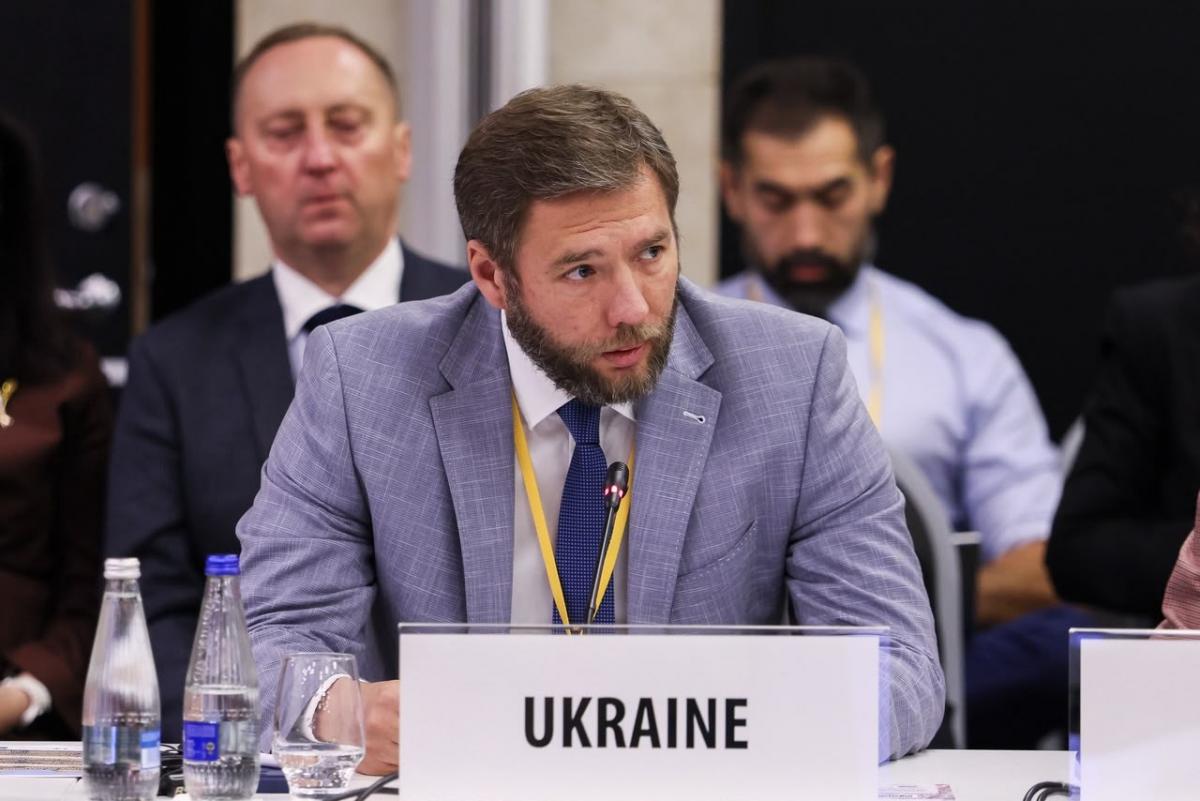
On 8 – 9 October 2026, Vitalii Gatseliuk, a member of the High Qualification Commission of Judges of Ukraine, participated in events at the Warsaw Human Dimension Conference, organised by the Swiss OSCE Chairpersonship with the support of the Office for Democratic Institutions and Human Rights of the Organisation for Security and Co-operation in Europe (hereinafter – ODIHR).
The Commission’s representative contributed to three formats of professional dialogue: a plenary session of the conference, an expert meeting at the ODIHR office, and a thematic side event addressing the relationship between special procedures for assessing judges’ compliance with professional ethics and integrity criteria (vetting) and guarantees of judicial independence.
Vitalii Gatseliuk opened his address at the conference’s plenary session with an example illustrating the realities of administering justice in Ukraine under martial law. While legal professionals were holding international discussions on safeguarding the rule of law in Warsaw, their colleagues in Kyiv were having to interview judicial candidates in a shelter because of the threat of Russian missile strikes and drone attacks.
The Commission member also recalled his nine years of service with the Office of the OSCE Project Co-ordinator in Ukraine and his involvement in preserving the OSCE’s programmatic presence after Russia blocked the extension of the Co-ordinator’s mandate in 2022.
Particular attention was paid to staffing the judiciary and restoring public trust in justice. With the Commission conducting competitive selection procedures to fill nearly 2,000 judicial positions in local courts and 550 vacancies in courts of appeal, as well as selecting judges for the high specialised administrative courts and the High Anti-Corruption Court, Vitalii Gatseliuk emphasised the importance of public and international participation in these procedures, particularly through the work of the Public Integrity Council, the Public Council of International Experts and the Expert Council. Their involvement is intended to enhance the transparency of competitive selection, the objectivity of candidate evaluation and trust in the outcomes of these procedures.
At the same time, efforts to ensure the proper functioning of the judicial system are taking place amid constant threats to the safety of judges, court staff and participants in judicial proceedings. According to the figures presented during his address, approximately 200 buildings housing 190 courts and justice system institutions have been damaged or destroyed since the start of the full-scale invasion. For example, just two weeks before the conference, a Russian drone struck the premises of the High Council of Justice.
In this context, the Commission member called on OSCE participating States to refrain from recognising acts of the occupation authorities, help bring those responsible to justice through universal jurisdiction and international justice mechanisms, support independent monitoring of violations, and assist Ukraine in reforming its judicial system and strengthening its resilience.
An expert meeting at the ODIHR office, attended by representatives of Albania and Moldova, addressed the results of mechanisms for assessing judges’ compliance with professional ethics and integrity criteria and their place in a long-term framework for safeguarding judicial integrity. Vitalii Gatseliuk reported that, since mid-2023, the Commission had completed the qualification assessment of 231 judges, of whom 45 had been found unsuitable for their positions. The central point of his address was the need for a gradual transition from exceptional vetting mechanisms to permanent instruments for ensuring judicial integrity and accountability. In the Commission member’s view, qualification assessment cannot remain a mechanism of judicial reform indefinitely. It must be complemented and ultimately replaced by effective institutional procedures: asset declarations, verification of integrity declarations and declarations of family ties, transparent competitive selection, and effective mechanisms of disciplinary and criminal liability.
“If mechanisms for ensuring judicial responsibility and accountability function properly on an ongoing basis, there will be no need to introduce further special judicial vetting procedures,” Vitalii Gatseliuk emphasised.
The final platform for presenting Ukraine’s experience was a thematic side event addressing the legal framework for special procedures to assess judges’ compliance with professional ethics and integrity criteria, their conformity with international standards, and the provision of adequate safeguards for judicial independence. During the discussion, Vitalii Gatseliuk outlined the conditions under which exceptional assessment mechanisms may be applied without undermining the fundamental guarantees of judicial status. These include a clear constitutional and legislative basis; uniform criteria and procedures for all judges; compliance with European Court of Human Rights standards on permissible interference with private life; appropriate professional and ethical standards for vetting bodies; judges’ awareness of assessment procedures; and responsible handling of personal data.
The legitimacy of such procedures depends not only on their purpose but also on legal safeguards, the predictability of the rules and their fair application to each judge.
“Special judicial vetting procedures do not undermine guarantees of judicial independence, provided that they are conducted lawfully and in accordance with the principles of proportionality, transparency and fair treatment of every judge,” the Commission member stated.
Vitalii Gatseliuk’s participation in the Warsaw Conference provided an opportunity to draw the international community’s attention to the particular challenges of reforming Ukraine’s judicial system during a full-scale war, when ensuring the continuity of judicial institutions must go hand in hand with further institutional transformation and the fulfilment of EU integration commitments.
The discussion of international approaches to judicial integrity vetting, safeguarding judicial independence and improving judicial career procedures facilitated an exchange of experience relevant to advancing judicial reform in Ukraine in accordance with the rule of law and international standards of judicial independence.
Further information on the key issues raised at the Warsaw Human Dimension Conference, as well as participants’ positions on safeguarding judicial independence and upholding the rule of law, is available here.


