
A strong judiciary is built where rules are clear, procedures are predictable, and decisions are reasoned and consistent. For the High Qualification Commission of Judges of Ukraine, this is not merely a matter of organisational importance but also of institutional significance, as transparent and consistent procedures for judicial selection, competitions and qualification assessment are directly linked to strengthening safeguards for judicial independence, legal certainty and public confidence in the administration of justice.
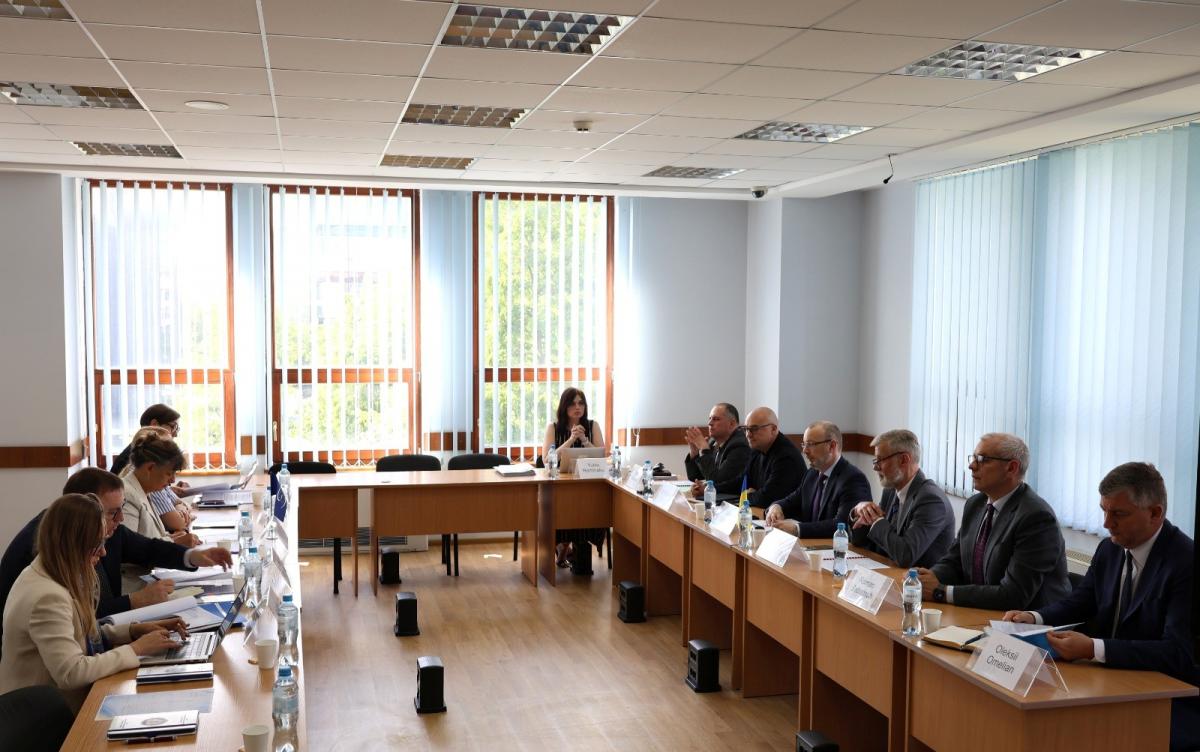
On June 23, 2026, the High Qualification Commission of Judges of Ukraine held a working meeting with representatives of the Council of Europe Directorate of Human Rights. The discussions focused on Ukraine’s implementation of judgments of the European Court of Human Rights in cases concerning the functioning of the judiciary, safeguards for judicial independence, access to the judicial profession, legal certainty regarding judges’ status in the context of judicial reform, as well as possible areas for further expert and methodological support to the Commission.
The meeting was attended by Oleh Koliush, the Deputy Chairman of the Commission, members of the Commission Ruslan Sydorovych, Ihor Kushnir, Roman Sabodash and Oleksii Omelian, as well as Yuliia Reminska, Head of the International Cooperation Division of the Commission’s Secretariat.
The Council of Europe was represented by Claire Ovey, Director of Human Rights at the Council of Europe; Pavlo Pushkar, Head of Division at the Department for the Execution of Judgments of the European Court of Human Rights; Ketevan Tskhomelidze, Head of Section at the Department; and Bozhena Malanchuk, Lawyer at the Department.
Opening the meeting, Oleh Koliush, the Deputy Chairman of the Commission emphasised that, as a judicial governance body, the HQCJ of Ukraine implements key procedures related to access to the judicial profession and judicial careers. These include, in particular, the selection of candidates for the position of a judge, the conduct of competitions for vacant judicial positions, and qualification assessment.
The representatives of the Council of Europe provided an update on the current state of supervision of Ukraine’s execution of judgments of the European Court of Human Rights, in particular in cases concerning the functioning of the judiciary and safeguards for judicial independence. The closure of the execution of the judgment in the case of Oleksandr Volkov v. Ukraine following the implementation of the relevant individual and general measures was highlighted separately. At the same time, the parties focused on groups of cases that remain under execution and require further institutional measures.
One of the key issues discussed at the meeting was the groups of cases of Denisov v. Ukraine and Holovchuk v. Ukraine, which are relevant to ensuring safeguards for judicial independence, legal certainty regarding judges’ status, the predictability of judicial careers, access to judicial office and procedures for the transfer of judges in the context of judicial reform.
Particular attention was paid to the group of cases concerning Svitlana Naumenko v. Ukraine, which addresses systemic challenges in the field of the effectiveness of justice, including the length of judicial proceedings, excessive workload within the judicial system and staff shortages in courts. In this context, representatives of the Council of Europe expressed interest in the ongoing competitive procedures conducted by the judicial governance body, projections for filling judicial vacancies and the Commission’s plans for the coming year.
During the meeting, representatives of the Commission provided information on the resumption and continuation of judicial selection, competitive and qualification assessment procedures following the establishment of its full membership. It was noted that the Commission is working simultaneously on completing procedures initiated in previous periods, conducting competitions for the courts of appeal, selecting candidates for judicial positions in courts of first instance, as well as conducting competitive procedures for specialised administrative courts.
One of the key issues discussed at the meeting was the staffing situation in the courts. Representatives of the Commission provided information on the need to fill a significant number of vacant judicial positions, including approximately 550 vacancies in the courts of appeal and approximately 1,800 vacancies in courts of first instance. In this context, the parties discussed ongoing competitive procedures, the establishment of a pool of candidates for judicial office, as well as approaches to forecasting the further staffing of courts.
The participants also focused on issues related to the development of the professional profile of candidates for positions as appellate court judges, the verification of judges’ declarations of integrity and declarations of family ties. Particular attention was also paid to the practical cooperation between the Commission and the Public Integrity Council and the Expert Council.
The Commission members emphasised the importance of appropriate methodological support for the selection of candidates for judicial office, competitive procedures and qualification assessment. Another area of discussion concerned European approaches to assessing integrity and professional ethics, as well as the application of relevant standards in procedures for the selection and assessment of judges.
For their part, the representatives of the Council of Europe emphasised the importance of appropriate communication between stakeholders involved in the selection and assessment processes, the balanced application of integrity and professional ethics standards, and the creation of conditions for the effective organisation of relevant processes within the remit of judicial governance bodies.
Following the meeting, the parties agreed to continue their professional dialogue and exchange information on the current status of competitive procedures, the selection of candidates for judicial office, projections for filling vacancies, and the Commission’s needs for external expert, methodological and organisational support.
The High Qualification Commission of Judges of Ukraine reaffirmed its readiness to continue cooperating with the Council of Europe on the execution of ECtHR judgments, strengthening safeguards for judicial independence, improving judicial career procedures and developing the institutional capacity of judicial governance bodies.
The meeting demonstrated a shared understanding that judgments of the European Court of Human Rights in cases related to the functioning of the justice system cannot be regarded merely as an external international legal obligation of Ukraine. Their proper execution is an integral part of upholding the rule of law in practical rather than merely declaratory terms. It is through the execution of such judgments that the State must address the underlying causes of legal uncertainty, ensure predictability in judicial career procedures and develop institutional practices in which judicial independence is guaranteed not only by law but also through the consistency, sound reasoning and legal quality of decisions taken by judicial governance bodies.


